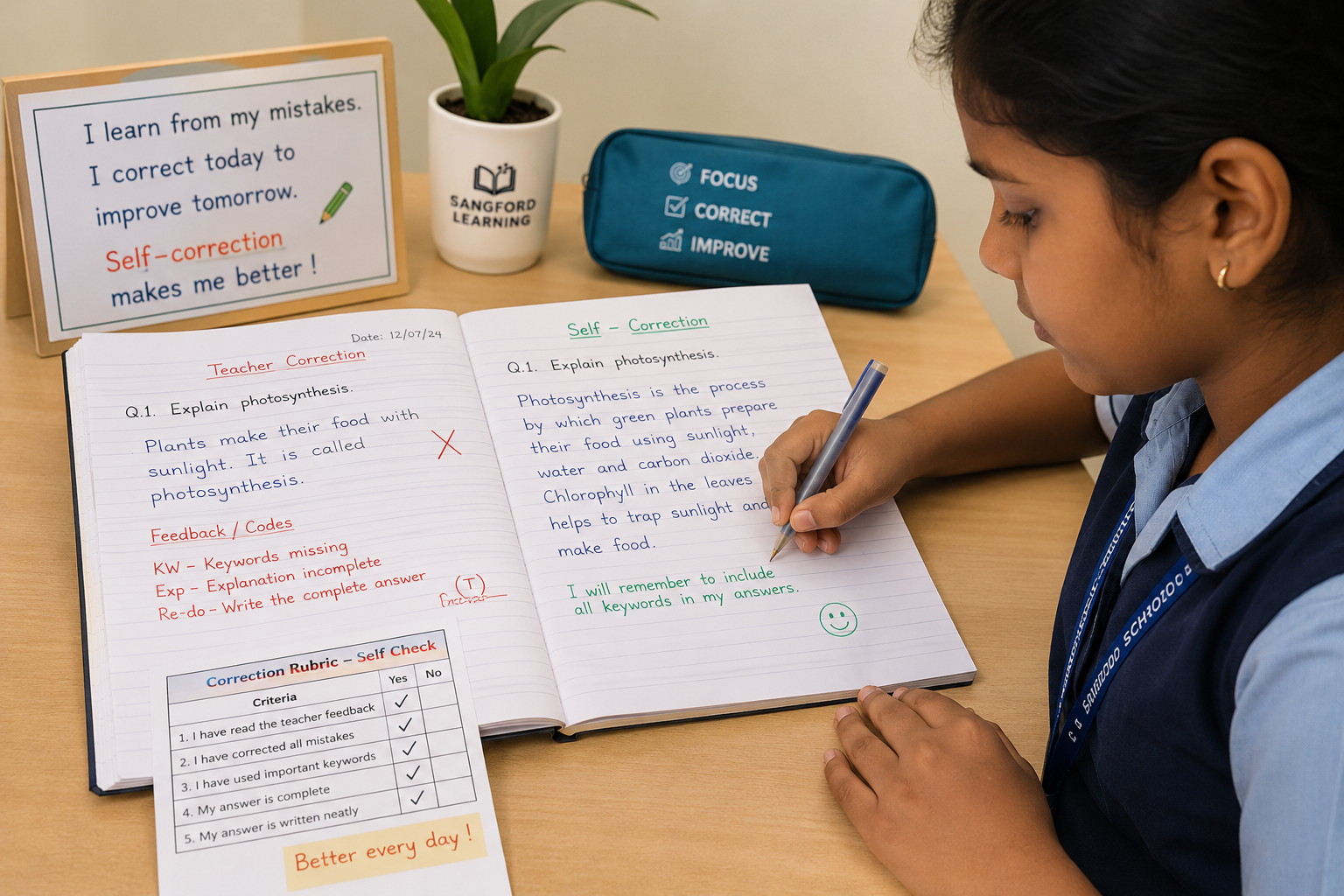
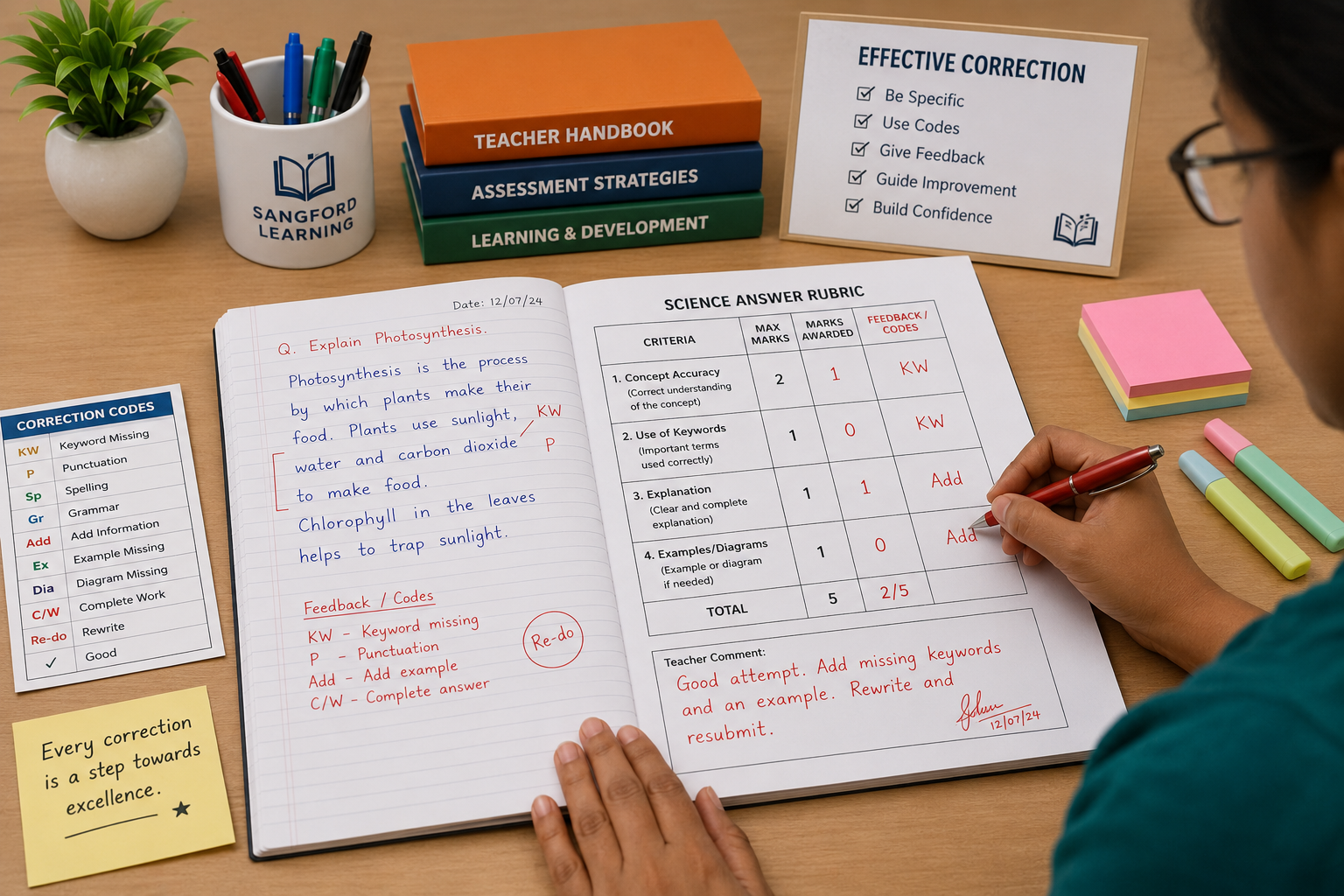
At Sangford Learning, we provide a complete KG to 12 CBSE correction rubric system for schools — covering notebooks, workbooks, composition notes, map books, lab books, language subjects, Maths, Science, Social Science, test papers, and term exam papers.
Our rubric system helps schools create a consistent correction culture where every teacher knows what to correct, how to correct, when to correct, and how students should complete follow-up corrections.
Correction should not begin only in Grade 10 or Grade 12. At Sangford, we believe board-exam readiness must be built gradually from KG onward through daily academic habits such as handwriting, spelling, sentence formation, step-by-step working, diagram labelling, map marking, keyword usage, self-correction, and exam discipline.

A Comprehensive Guide for Teachers, Students and Parents
Explore each part and question using the + symbol. Open only the guidance you need, or use the controls below to expand or collapse the complete guide.
This section helps teachers understand how to evaluate answer sheets fairly, consistently and according to the approved marking scheme.
The guiding principle for fair valuation is:
Every mark must be awarded for identifiable evidence demonstrated in the student’s answer—not according to the personal impression of the correcting teacher.
A paper-valuation rubric explains:
It helps ensure that the same answer receives approximately the same mark regardless of which trained teacher evaluates it.
For a three-mark numerical, the rubric may specify:
The teacher should not simply read the answer and decide, “This looks like a two-mark answer.”
No.
CBSE normally provides a separate:
for each subject and examination.
Therefore, teachers should not create their own mark divisions during correction. The approved question-specific marking scheme must guide the evaluation.
A three-mark Biology question may carry:
A three-mark Physics numerical may carry:
Both questions carry three marks, but they cannot be corrected in the same way.
A value point is a scientifically, mathematically, linguistically or factually correct and separately identifiable part of an answer for which marks can be awarded.
A value point may be:
Question: Why is the magnetic field stronger near the poles of a magnet?
Possible value points are:
Each point represents evidence of scientific understanding.
No.
A keyword is an important technical term. A value point is a complete idea that answers the question.
Question: How do plants remove excess water?
Student writes:
“Transpiration.”
This is only a relevant keyword.
Better answer:
“Plants remove excess water through stomata by transpiration.”
The second answer communicates the complete scientific idea.
Keywords alone do not automatically earn a mark.
The keyword must be used correctly and meaningfully within the answer.
No.
Students may express the correct idea in their own words.
Marks should be awarded when:
Expected answer:
“Silver is a better conductor of heat than aluminium.”
Student writes:
“Heat passes through silver faster, so the wax melts earlier.”
The wording is different, but the scientific meaning is correct. Marks should be awarded.
Do not compare the student’s answer word-for-word with the model answer.
Evaluate the meaning.
Award full marks when:
Award partial marks when:
Award zero when:
A two-mark question requires two valid reasons.
No.
Half marks should be awarded only when the answer has clearly divisible and separately assessable components.
Teachers must not give ½ mark merely because:
A question asks:
Identify the eye defect and name the correcting lens.
Possible allocation:
This division must be decided before correction begins.
Normally, no.
For a standard one-mark MCQ:
For Assertion–Reason questions, the student must select the correct complete option. Half marks are not normally awarded because one statement was judged correctly.
The student marks both option B and option C.
Because the final response is uncertain, the answer normally receives zero.
The teacher should not guess which answer the student intended.
Numerical problems should be evaluated step by step.
Depending on the total marks, the rubric may assess:
A wrong final answer does not automatically mean zero.
A consequential error occurs when one early mistake affects the later steps.
The teacher should:
A student incorrectly calculates resistance as 12 Ω instead of 10 Ω.
The student then correctly uses 12 Ω in the next formula and follows the proper method.
The teacher should deduct marks for the first calculation error but may award the later method mark.
A correct final answer does not always deserve full marks.
When the student uses:
the student should not receive method marks.
A student uses the wrong lens formula but coincidentally obtains the correct focal length.
The teacher may award only the final-answer component, if the rubric provides a separate mark for it.
The incorrect formula and method should not receive marks.
A student may still earn method marks when:
Correct working gives:
5 × 4 = 20
The student accidentally writes:
5 × 4 = 25
The calculation mark may be lost, but formula and substitution marks should be retained.
These are different errors and should be evaluated separately.
The student selects the wrong law or equation.
The student uses an incorrect positive or negative sign.
The correct formula is written, but the values are placed incorrectly.
The numerical value is correct, but the unit is missing or wrong.
Correct answer:
5 A
Student writes:
5
If the formula, substitution and calculation are correct, only the unit-related component should be affected. The entire numerical should not be cancelled.
No.
A student should lose marks for a missing diagram only when:
When a diagram carries marks, the teacher may check:
A magnetic-field diagram has the correct pattern but no arrow direction.
The teacher should deduct only the direction-related mark, not necessarily the entire diagram mark.
Scientific accuracy matters. Artistic beauty does not.
Depending on the question, the teacher should check:
The student writes the correct reactants and products but does not balance the equation.
If the rubric divides the marks, the student may receive credit for the correct chemical substances but lose the balancing component.
A word equation should not receive full marks when a balanced chemical equation is specifically required.
No.
They are separate answer components.
What the student sees during the experiment.
Why the observed change occurred.
Observation:
A reddish-brown coating forms on the iron nail.
Reason:
Iron displaces copper from copper sulphate solution.
If the question asks for both, writing only the observation does not earn the reason mark.
Minor grammar or spelling errors should not reduce content marks when the meaning is clear.
The student writes:
“Photosynthasis”
If the intended word is clearly “photosynthesis,” the content mark need not be reduced.
However, an error that changes the meaning must be treated as a conceptual error.
“Concave lenses converge light.”
This is not merely a language mistake. It is scientifically incorrect.
The same value point should receive marks only once, even when it is written repeatedly in different words.
These statements may communicate the same value point. They should not receive three separate marks.
Do not penalise it.
It may be ignored if it does not affect the answer.
It may affect marks when it:
“Convex lenses converge light. They also diverge parallel rays.”
The second statement contradicts the first. Full marks should not be awarded.
When a student writes two mutually contradictory statements, the teacher should not select the correct one on the student’s behalf.
“The image is real and virtual.”
Unless the question describes two different conditions, this answer shows uncertainty.
The teacher should award only the marks supported by clear and unambiguous understanding.
The school must establish one uniform policy before correction.
A recommended rule is:
Option A carries five marks and Option B carries five marks.
The student earns two marks from A and three marks from B.
The teacher must not combine them to award five marks.
The approved policy must be applied to every student.
Teachers must follow the examination instructions.
They should not create different rules after seeing the student’s answers.
A section asks students to answer any four questions, but the student attempts five.
The teacher should follow the approved extra-question policy and mark the unused response clearly as “Extra.”
The rule must be the same for all students.
Yes, when the answer is:
The marking scheme gives sodium as an example of a highly reactive metal extracted through electrolysis.
A student writes potassium with a correct explanation.
If potassium is scientifically valid for the question, the answer should be accepted.
The teacher should not make an isolated decision.
The answer should be:
A student uses a scientifically valid method different from the method shown in the answer key.
The subject team should verify it and award appropriate marks to every student who used the same valid method.
The question-paper setter should prepare:
Before conducting a three-mark ray-diagram question, the setter should decide whether marks are assigned for:
These marks must not be invented during correction.
Different teachers may interpret the same marking scheme differently.
Before independent correction, teachers should jointly discuss:
Jointly correct:
Any marking differences should be resolved before full correction begins.
Yes.
A student may:
The first sentence is correct, but the final sentence contradicts it.
If the teacher stops after the first sentence, the answer may incorrectly receive full marks.
Teachers should:
(a) 1/1
(b) ½/1
(c) 2/2
Total: 3½/4
This makes the marking clear to the student, moderator and parent.
Teachers should use a limited and common set of codes.
Examples:
Instead of writing only “Wrong,” the teacher may write:
F — Formula incorrect
This helps the student understand exactly what must be corrected.
When changing an awarded mark, the teacher should:
Do not erase the old mark completely.
The mark change must remain transparent and verifiable.
Moderation is the review of corrected papers to ensure:
Moderation is not intended to find fault with teachers. It protects students and the integrity of the examination.
The school should:
One teacher awards ½ mark for an unbalanced equation, while another awards zero for the same response.
Once the common rule is finalised, all similar papers must be rechecked—not only the paper where the difference was noticed.
No.
Grace marks may be awarded only when:
A question contains incorrect data and cannot be solved.
The examination committee may approve marks for all eligible students. An individual teacher should not independently award or deny grace marks.
Every answer paper should receive two levels of verification.
By the correcting teacher.
By another teacher, moderator or examination-team member.
They should verify:
Question-wise marks total 62½, but the front page shows 61½.
The second-level check should identify and correct this error before results are released.
When a student or parent raises a concern, the teacher should:
The response must be based on evidence, not defensiveness.
Teachers should avoid vague remarks such as:
Better feedback identifies the precise issue:
Instead of:
“Improve.”
Write:
“VP — Scientific reason missing. Explain why the colour changed.”
Teachers should analyse:
If most students use the wrong sign for focal length, the class needs reteaching and targeted practice on sign convention—not merely additional marks discussion.
For each major examination, the subject team should retain:
These records support future examinations, teacher training and academic quality reviews.
Every teacher should be able to explain:
A teacher should not say:
“This is how I usually correct.”
The teacher should be able to say:
“This is the approved valuation rule applied to the evidence in the student’s answer.”
No.
The rubric should also guide the correction of:
Daily correction helps students build the habits needed for major examinations.
If a student regularly forgets units in classwork numericals, the teacher should use the correction code U immediately.
Waiting until the term examination to correct this habit may allow the same mistake to become permanent.
Correction should match the student’s age and level of learning.
Teachers may focus on:
Teachers may add:
Teachers should focus on:
Correction should become more academically demanding as the student progresses, but the basic habit of checking and correcting work should begin from KG.
Board-examination readiness is not created only during Class 10 or Class 12.
It develops through daily habits such as:
A Class 6 student who learns to show every calculation step is better prepared for step marking in later board examinations.
Daily correction should therefore be treated as long-term examination preparation.
Correction is incomplete until the student has acted on the feedback.
The teacher should verify whether the student has:
The teacher writes:
L — Diagram label missing
The student should not merely add the label by copying from another student.
The teacher should check whether the student now knows the correct part and can label a similar diagram independently.
Teachers should look for patterns across:
Repeated errors may include:
If a student receives the code U in three different tests, the issue should be treated as a repeated learning habit—not as three unrelated careless mistakes.
The teacher should provide targeted practice and monitor improvement.
A common correction-code system helps:
When Inc means “Incomplete answer” in every class and subject, the student does not need to learn a different symbol from each teacher.
Teachers may add subject-specific codes where necessary, but the main school codes should remain common.
Correction frequency should match the class level, subject and volume of work.
Recommended practice:
The school may adjust the schedule according to the subject timetable, but correction should never be delayed for long periods.
Regular and meaningful correction is more useful than correcting a large quantity of work only at the end of the month.
No.
The common correction principles should remain the same, but subject-specific expectations must also be followed.
Teachers should check:
A common school correction system should create consistency without ignoring the special requirements of each subject.
Teachers should not rewrite the entire composition or long answer for the student.
The teacher should:
Teachers may check:
Instead of rewriting a complete paragraph, the teacher may write:
Gr — Check sentence structure
Format — Required letter format not followed
Re-do — Rewrite the introduction
Correction should help the student become a better writer. It should not make the teacher the writer of the student’s answer.
Correction quality should be reviewed regularly by the coordinator, subject head or Principal.
The review may check:
Recommended evidence may include:
Monitoring should not focus only on whether a notebook contains ticks. It should check whether correction is helping the student improve.
Teachers should check whether the student has demonstrated the correct:
Students need not reproduce the exact wording of the textbook or marking scheme.
Correct idea expressed in different words → Award marks
Correct keyword included in an incorrect answer → Do not award marks
The teacher must evaluate the complete meaning, correctness and evidence of learning in the student’s response.
A corrected answer sheet is not only a record of your marks. It is a learning tool that shows:
The guiding principle for effective student learning is:
Do not look only at the final score. Understand why each mark was gained or lost.
First, do not look only at the total mark.
Check every question where:
For each such question, identify:
Question: Why does distilled water not conduct electricity?
Your answer:
“Because it is pure.”
Teacher’s correction:
VP — Reason incomplete
What you should learn:
Distilled water contains very few ions, so it conducts electricity poorly.
The total mark tells you how much you scored. It does not tell you what you need to improve.
Two students may both score 60 marks, but their learning needs may be different.
Student A loses marks because of:
Student B loses marks because of:
Both students scored the same total, but they need different types of practice.
A value point is an important and complete idea required in the answer.
It may be:
Question: Why is the magnetic field stronger near the poles of a magnet?
Possible value points are:
Each complete idea may carry a mark according to the marking scheme.
Not always.
A keyword is an important subject word, but it may not explain the complete idea.
Question: How do plants remove excess water?
You write:
“Transpiration.”
This is only a keyword.
Better answer:
“Plants remove excess water through stomata by transpiration.”
The second answer shows complete understanding.
Keywords alone may not earn a mark. Use the keyword correctly in a complete and relevant answer.
Yes.
You do not always need to copy the exact textbook or marking-scheme sentence.
You may write the answer in your own words when:
Expected answer:
“Silver is a better conductor of heat than aluminium.”
You write:
“Heat travels through silver faster, so the wax melts earlier.”
The wording is different, but the meaning is correct.
A keyword receives a mark only when it is connected correctly to the answer.
Question: Which lens corrects hypermetropia?
You write:
“Hypermetropia is corrected by a concave lens. A convex lens is used for myopia.”
The words convex lens appear in the answer, but they are connected to the wrong eye defect.
Therefore, the keyword does not prove correct understanding.
A correct word inside an incorrect answer does not automatically earn marks.
Partial marks are awarded when some separately markable parts of your answer are correct and others are missing or wrong.
A two-mark question asks for two reasons.
You write:
You may receive:
Total: 1/2
Partial marks are not given merely because you attempted the question. They are awarded for correct evidence.
Yes, but only when the question or marking rubric divides the answer into smaller parts.
Question: Name the eye defect and the correcting lens.
Possible mark division:
If you write only one correct part, you may receive ½ mark.
Half marks are not encouragement marks. They are awarded for a clearly correct part of the answer.
Normally, no.
For a standard one-mark MCQ:
You select both B and C.
Even if C is correct, the final answer is unclear. The teacher cannot guess your intended answer.
Your response becomes contradictory.
You write:
B — Insulin from pancreas
But option B in the question paper is not “Insulin from pancreas.”
The teacher must follow the school’s approved rule.
To avoid confusion, write:
Multi-mark numerical questions award marks for the method, not only the final answer.
The steps may include:
For a three-mark numerical:
If you write only the final number, the teacher cannot award invisible method marks.
Yes, when your earlier method is correct.
You write the correct formula and substitute the correct values, but make an arithmetic mistake in the final step.
You may still receive marks for:
You may lose only the calculation or final-answer mark.
Show every important step. Correct working can earn marks even when the final answer is wrong.
Normally, no.
A correct final answer obtained through:
does not demonstrate complete understanding.
You use the wrong lens formula but obtain the correct answer by coincidence.
You may receive only the final-answer mark, if it is separately allotted. You should not receive the formula or method marks.
A consequential error happens when one early mistake affects the later steps.
You calculate resistance incorrectly in Step 1.
You then use that incorrect resistance correctly in Step 2.
The teacher may:
One early mistake may reduce marks, but correct later working should still be shown.
A numerical answer is often incomplete without a unit.
Correct answer:
5 A
You write:
5
The number may be correct, but the unit is missing.
If the unit has a separate mark, you may lose only that component.
In optics and other numerical topics, positive and negative signs have scientific meaning.
For a convex mirror:
A wrong sign may change the result.
Write the correct formula first, apply the sign convention carefully and then substitute the values.
No.
A diagram is required when:
If the question says:
“Draw a labelled ray diagram,”
you must include the diagram and labels.
If the question asks only to name the image type, an unnecessary diagram may not be required.
No.
A Science diagram is assessed for scientific correctness, not artistic beauty.
The teacher may check:
A magnetic-field diagram has the correct pattern but no arrows.
You may lose only the arrow-direction component rather than the entire diagram mark.
A diagram and its labels may carry separate marks.
You draw the correct human-neuron diagram but do not label:
The diagram may receive some credit, but the labelling mark may be lost.
After drawing a diagram, check:
Depending on the question, you may need to include:
If the question asks for a balanced chemical equation, writing only a word equation may not receive full marks.
Before finishing, ask:
What you see during an experiment.
Why the observation happened.
Observation:
A reddish-brown coating forms on the iron nail.
Inference:
Iron displaces copper from copper sulphate solution.
If the question asks for both, you must write both separately.
Some processes must happen in a correct scientific order.
A nerve impulse travels:
Dendrite → Cell body → Axon → Synapse
If the sequence is written incorrectly, the scientific explanation becomes wrong.
For process questions:
No.
Marks are awarded for correct and relevant value points, not for the number of lines.
For a one-mark question:
“Insulin is secreted by the pancreas.”
This is complete.
Writing the full structure and function of the pancreas is unnecessary unless the question asks for it.
Write enough to answer the question completely—but avoid unrelated information.
A repeated point receives marks only once.
These may communicate the same idea.
They do not automatically become three separate value points.
Use each point to add a new idea, not to repeat the same idea in different words.
Extra correct information usually does not reduce marks.
Extra irrelevant information may be ignored.
However, extra incorrect information may reduce marks when it:
You write:
“Convex lenses converge light. They also diverge parallel rays.”
The second sentence contradicts the first. Full marks should not be expected.
The teacher cannot choose the correct one for you.
You write:
“The image is real and virtual.”
Unless the question describes two different situations, the answer is contradictory.
Before submitting, read the complete answer and remove statements that conflict with each other.
Minor spelling or grammar errors may not reduce content marks when the meaning is clear.
You write:
“Photosynthasis”
If the word clearly means “photosynthesis,” the teacher may accept it.
However, an error that changes the scientific meaning is not a small language error.
“Chlorophyll is a hormone.”
This is a conceptual error.
No.
Underlining may make the answer easier to read, but marks are based on content.
A correct answer without underlining should receive the same content mark as a correct answer with underlining.
Underline only important terms. Do not underline every sentence.
Poor handwriting should not reduce content marks when the answer is readable.
However, the teacher cannot award marks for a word that cannot be read.
Write clearly enough for the examiner to identify:
You are normally expected to attempt only one option.
If both are attempted, the teacher will follow the school’s approved rule.
A common rule is:
Marks from two different options should not be combined.
You earn:
The teacher should not combine them to give 5 marks.
The teacher must follow the examination instructions.
The paper says:
“Answer any four questions.”
You answer five.
One answer may be treated as an extra response according to the approved rule.
Read the instructions carefully before answering.
Yes.
A method different from the answer key may receive full marks when:
You calculate electrical power using:
Any suitable formula may be accepted when the required values are available.
Correction codes show the exact reason for mark loss.
Common codes include:
The teacher writes:
Cal
This means your method may be correct, but your calculation contains an error.
Do not simply copy the corrected answer.
First understand what the code means.
Teacher code: U
Do not write only:
“Unit missing.”
Write:
My mistake:
“I calculated the current correctly but did not write ampere.”
Corrected answer:
“Current = 5 A.”
Next action:
“I will check the final unit after every numerical.”
Please click and download the Student Self-Correction document
Write the real reason.
Possible reasons include:
Avoid vague statements such as:
Write one specific action.
“I will study properly.”
A specific action is easier to complete and verify.
You need not rewrite every fully correct answer.
You should correct:
Correction is complete only when you understand the correct answer—not merely when you copy it.
After each test:
You repeatedly lose marks for missing units.
Your action plan should be:
Use the final five minutes to check:
Do not use the final minutes to start an unnecessary long answer. Use them to protect marks already earned.
No.
You should also use correction feedback in:
Small mistakes corrected during daily work are less likely to appear in major examinations.
Your teacher writes KW in a notebook answer.
Correcting the missing keyword immediately helps you remember the correct term before the next test.
When correction is delayed, you may:
You use the wrong sign convention in today’s optics practice.
If you correct it today and practise two similar questions, the error can be stopped early.
If you ignore it, the same mistake may appear in the examination.
Board-examination performance is built through regular habits.
These include:
A student who regularly checks units in classwork is less likely to lose unit marks in the board examination.
Good examination habits are developed gradually, not only during final revision.
Use your correction codes and self-correction records to identify patterns.
You may notice:
The subject content is different, but the common problem is that your answers are incomplete.
Your improvement action may be:
“Before finishing each answer, I will check whether I have answered every part of the question.”
Do not treat it as another small mistake.
Follow these steps:
You repeatedly receive Cal for calculation errors.
Your action should not be only:
“I will be careful.”
A better plan is:
Corrections in notebooks and workbooks help you understand mistakes before they are repeated in tests and examinations.
Do not erase or rewrite a mistake only to make the page look neat. Use the teacher’s feedback to understand:
The purpose of the correction is not to make the page look clean. It is to make the learning clear and prevent the same mistake from happening again.
After receiving correction, you should:
Do not copy the corrected answer without understanding it. Correction is complete only when you can explain the mistake, apply the correct learning and solve a similar question independently.
A good presentation helps the teacher understand your work clearly and prepares you for examinations.
You should:
Presentation does not replace correct content, but poor presentation can hide correct learning and cause avoidable mistakes.
Homework should show your own understanding and effort.
Before asking for help:
Avoid:
Homework is not only for submission. It helps the teacher understand what you can do independently.
Different academic records require different checks.
Check:
Check:
Check:
Do not treat these records as copying work. You should understand the composition, location, experiment, observation and conclusion.
Your mark does not depend only on how much you studied. It also depends on how clearly you show your learning in the answer sheet.
Always ask:
Correct idea in clear words → Marks can be awarded
Keyword without correct meaning → Marks may not be awarded
Correct method with a small later error → Method marks may still be awarded
Correction understood and practised → The same mistake is less likely to happen again
A child may lose marks because of:
In many places, examination preparation follows a repeated pattern:
Read → Write → Read → Write → Memorise → Forget
This approach may help students remember information for a short time, but it does not always build deep understanding, long-term memory, independent thinking or the ability to apply learning in unfamiliar questions.
When students repeatedly study without understanding, write the same answer many times and continue attending long hours of tuition after school, they may experience:
More study time does not always produce more marks. Students score better when they understand what they learn, remember it meaningfully, apply it correctly and present it clearly in the examination.
At Sangford Learning, higher marks are developed through learning principles, not through endless repetition alone.
Students are supported through:
These learning techniques help students:
Sangford does not treat learning as only:
Read → Copy → Memorise → Reproduce
Instead, students are guided through a stronger learning cycle:
Understand → Practise → Retrieve → Apply → Check → Correct → Improve
This cycle helps students move from short-term memorisation to meaningful learning.
It also helps them:
A stress-reduced learning environment does not mean removing expectations, assessments or academic discipline.
It means that students are supported through:
When students feel safe to make mistakes and learn from them, they are more likely to participate, ask questions and improve.
Fear may produce short-term compliance. Understanding and confidence produce stronger long-term performance.
After tests and examinations, Sangford does not stop with the final score.
Students are guided to identify:
This helps students turn mistakes into learning opportunities.
Example:
A student who repeatedly loses marks for missing units does not simply receive the remark “Be careful.”
The student is trained to:
This targeted correction is more useful than repeatedly asking the student to “study harder.”
Students score more when they can:
Sangford’s learning techniques are designed to strengthen these exact skills.
The goal is not to reduce academic standards. The goal is to help students meet high standards through better learning methods and lower unnecessary stress.
Parents can support this approach by asking not only about marks, but also about learning.
Instead of asking only:
“How many marks did you get?”
Parents can also ask:
Ask not only:
“How many marks did you get?”
Also ask:
“What did you understand, where did you lose marks, and how will you improve?”
Marks are important. Learning is important. Confidence, health and balance are also important.
Sangford Learning aims to help students achieve higher marks through deeper understanding, effective learning techniques, SIS Dashboard and Predictive Analysis, systematic correction and a supportive, stress-reduced learning environment.
A correction rubric explains how marks are awarded and why marks are lost.
It helps parents understand:
A child scores 1 out of 3 in a numerical problem.
Without a rubric, a parent may think:
“The answer is wrong.”
With the rubric, the parent may understand:
The correct support is not “study harder.” The child needs practice in substitution.
No.
The total mark shows performance in one assessment. It does not fully explain:
Two students scored 65 marks.
Student A lost marks because of weak concepts.
Student B lost marks because of missing units, labels and poor time management.
Both students need different support.
Constantly asking only about marks can make the child feel that the score is more important than learning.
This may lead to:
Marks are important, but parents should also notice:
Instead of asking only:
“How much did you score?”
Parents can ask:
These questions help the child think and improve.
A value point is a complete and important idea required in the answer.
It may be:
Question: Why is the magnetic field stronger near the poles?
Possible value points:
The child must show the required ideas, not merely write many lines.
A keyword is an important word, but it may not show complete understanding.
Question: How do plants remove excess water?
Child writes:
“Transpiration.”
This is a keyword.
Complete answer:
“Plants remove excess water through stomata by transpiration.”
The second answer explains the idea clearly.
A correct word inside an incomplete or incorrect answer may not receive full marks.
Yes.
Children need not always reproduce the exact textbook sentence.
Marks should be awarded when:
Expected answer:
“Silver is a better conductor of heat than aluminium.”
Child writes:
“Heat passes through silver faster, so the wax melts earlier.”
The wording is different, but the scientific meaning is correct.
Parents should encourage understanding, not only memorisation.
In Mathematics and Science numericals, marks may be awarded for different steps.
These may include:
For a three-mark numerical:
If the child uses the correct formula and method but makes one arithmetic error, the child may still receive method marks.
This is fair because the child has shown partial learning.
A correct final answer does not always prove correct understanding.
The child may have:
The child uses a wrong lens formula but gets the correct number by coincidence.
The final-answer mark may be awarded if separately allotted, but the method marks should not be given.
Steps show how the child reached the answer.
Without visible working, the teacher cannot know whether the child:
Encourage the child to show:
Do not encourage shortcuts that hide the method.
These are part of the subject knowledge.
A number without a unit may be incomplete.
Example:
A diagram may carry marks for:
A correct diagram without labels may lose the label-related mark.
Parents should not say:
“The answer is almost correct, so the teacher should give full marks.”
The missing component may carry a separate mark.
No.
Science diagrams are checked for:
Marks should not depend on artistic beauty.
A simple, clear and scientifically correct diagram is sufficient.
Not always.
In Science, Mathematics and Social Science, minor language errors may not reduce content marks when the meaning is clear.
“Photosynthasis” may be accepted if the intended word is clearly “photosynthesis.”
However, a statement such as:
“Chlorophyll is a hormone”
is not a spelling error. It is a conceptual error.
Parents should understand the difference between a minor language mistake and a wrong subject idea.
Extra correct information normally does not reduce marks.
However, extra wrong information may:
The child writes:
“A convex lens converges light. It also diverges parallel rays.”
The second sentence contradicts the first.
The teacher cannot ignore the incorrect statement and award full marks.
Self-correction helps children:
Correction is not complete when the child only copies the answer.
The child should understand:
Parents may check whether the child has written:
“I made a silly mistake.”
“I used diameter instead of radius. I will practise five similar problems.”
Parents should encourage specific correction, not vague promises.
No.
Tuition may be useful when a child has:
However, tuition should not automatically be treated as necessary for every child.
Parents should first understand:
Yes.
A child who finishes school and immediately attends long tuition sessions may experience:
More study time does not always mean better learning.
The quality of learning matters more than the total number of hours.
The child may become confused when:
In Mathematics, the school may train the child to show full steps.
Tuition may encourage a shortcut.
The child may then write only the final answer in the examination and lose method marks.
Parents should ensure that external support does not conflict with school expectations.
Parents should ask:
Tuition should solve a clear problem, not become an automatic daily routine.
A healthy daily routine should include:
A child’s entire day should not be filled only with school, tuition, homework and tests.
Balance supports:
Sleep supports:
A tired child may:
Parents should not reduce sleep in order to increase study time.
Possible signs include:
These signs should not be dismissed as laziness.
The child may need rest, reassurance and a more balanced schedule.
Avoid immediate anger, comparison or punishment.
Instead:
“Let us see where the marks were lost and plan how to improve.”
“You are careless. Look at your friend’s marks.”
No.
Comparison may lead to:
Compare the child’s present performance with the child’s earlier performance.
Ask:
Repeated mistakes indicate that the child needs:
The child repeatedly forgets units.
The solution is not to say:
“Be careful.”
A better plan is:
Parents should create the conditions for learning while allowing the child to think, attempt, correct and improve independently.
Parents can:
Parents should avoid:
Effective support should strengthen the child’s confidence, responsibility and ability to learn independently.
Parents may encourage:
Learning should not always follow only:
Read → Write → Read → Write
Different learning techniques help children understand, remember and apply knowledge.
When children explain a concept in their own words, parents can understand whether they truly understand it.
Ask:
“Can you explain why distilled water conducts poorly?”
A child who understands may say:
“It has very few ions, so electric current cannot pass easily.”
This is more meaningful than repeating a memorised sentence without understanding.
Correction codes give a quick explanation of mark loss.
Examples:
Parents should use the code to guide improvement, not to argue immediately about the mark.
Parents should:
The discussion should focus on:
It should not focus only on gaining one additional mark.
Standardised correction helps ensure that:
This protects both students and teachers.
Board-exam preparation is not only:
It also includes:
Sangford Learning supports students through:
The purpose is not only to increase marks.
The purpose is to help students:
Parents should work with the school and the child as one team.
Parents can support by:
School, parent and child should follow one clear learning goal.
Before an examination, parents should:
A calm child often performs better than an exhausted child.
After the examination:
The purpose is improvement, not punishment.
Parents should speak with the school when the child shows:
Early communication helps the school and family support the child together.
Marks matter, but children matter more.
Parents should support:
The goal is not only to produce a child who can score marks.
The goal is to develop a child who can:
No.
The rubric also supports the correction of:
Daily correction helps the school identify learning gaps before they become examination problems.
A child who repeatedly misses diagram labels in notebook work can receive support before losing the same marks in a major examination.
Young children gradually develop academic habits.
Early correction may focus on:
As children grow, the same correction habit develops into:
Starting early makes correction a normal part of learning rather than a punishment introduced only during board-examination classes.
Parents need not evaluate or correct the subject content themselves.
During a routine review, they may check whether:
If the teacher has written Re-do, parents can ask:
“Can you explain why this answer needs to be rewritten?”
This is more helpful than asking only:
“Did you finish the correction?”
Routine checking should help the child become responsible for completing and understanding schoolwork.
Last-minute revision may help children remember information temporarily.
Daily correction helps children:
Correcting one formula error during regular practice is easier than correcting the same misunderstanding across twenty questions before the final examination.
Parents can:
Parents should avoid:
“What did you learn from this correction?”
“Why do you always make mistakes?”
A common correction system reduces confusion.
When teachers, students and parents understand codes such as:
Everyone can discuss the exact learning issue.
Instead of saying:
“The teacher cut marks unnecessarily,”
the parent can understand:
“The answer received the code VP because one required value point was missing.”
This makes school–parent communication clearer and more evidence-based.
Parents should look for progress over time.
Useful indicators include:
Improvement should not be measured only by one test mark.
The reduction of repeated errors is also an important sign of learning.
Parents should look beyond whether one correction has been completed. They should monitor whether the child is learning from feedback and reducing repeated mistakes.
Parents may check whether:
The parent’s role is to monitor progress and encourage responsibility—not to replace the teacher, provide the answer or complete the correction for the child.
Homework should show what the child can understand and complete without excessive adult assistance.
Parents may:
Parents should avoid:
An imperfect but honest independent attempt gives the teacher useful learning evidence. A perfect answer produced with adult help may hide the child’s actual learning need.
Different records require different types of support.
Parents may check whether the child has followed the topic, paragraph structure, prescribed format and word limit.
Mathematics work
Parents may check whether steps are shown and whether the final answer includes the required unit.
Science records
Parents may check whether diagrams are labelled and whether laboratory records include the aim, observation, result and precautions.
Social Science and map work
Parents may check whether locations, labels, spellings, titles and legends are completed accurately.
Parents should check whether the child has understood and completed the work. Subject accuracy should be verified by the teacher.
Regular reviews help the school verify whether:
Parents should view notebook review as part of the school’s academic quality system, not merely as a presentation check.
Do not ask only:
“How many marks did you get?”
Also ask:
“What did you understand?”
“Where did you lose marks?”
“What did you correct?”
“What will you do differently next time?”
“Are you getting enough rest?”
“Do you need help?”
Marks are important.
Learning is important.
Health is important.
Balance is important.
All four are necessary for long-term success.